- English
- 中文版


Amazon Q1 2026 Earnings Outlook: Betting on AI Investment for Sustainable Profit Growth

Investor attention is increasingly focused on Amazon’s Q1 2026 report, at a juncture where the company’s ability to translate an aggressive, AI-driven capital expenditure cycle and continued cloud expansion into durable revenue growth and margin improvement is being put to the test. These results are likely to serve as a critical inflection point in shaping forward expectations for the stock, particularly in determining the company’s AI-led investments in delivering sustainable value creation.
Q1 2026 Earnings Expectations: Efficiency or Expansion at Any Cost?
The upcoming earnings release, scheduled for April 29, 2026, is drawing attention not just from a headline earnings perspective, but more importantly for what it reveals about the quality of capital spending and the company’s ability to convert elevated capital expenditures into sustainable operating profit. In a market environment that has become increasingly less tolerant of delayed returns on such investments that were estimated to be around $200 Billion, this report stands as a direct gauge of Amazon’s ability to strike a balance between growth ambitions and financial discipline especially as investment intensity across the technology sector remains elevated.
Analyst Expectations Point to Premium Pricing That Demands Execution Precision
Consensus estimates point to earnings per share EPS of $1.69, reflecting a balance between post holiday seasonal normalization and a continued emphasis on cost efficiency. While this figure appears relatively modest, it also signals expectations of disciplined execution capable of absorbing the impact of ongoing infrastructure expansion.
Revenue projections are centered around $177.1 billion, with investors monitoring operating income and cloud segment growth. These metrics are being evaluated not only in terms of scale, but also through the lens of growth quality and margin levels raising a broader question around why strong top-line performance does not always translate into equally strong underlying profitability.
Last Quarter’s Earnings Surprise Refocuses the Market on Quality of Profits
The 5.6% post-earnings decline in Amazon’s share price following its previous earnings call underscored a shift in market priorities toward earnings quality and margin durability, rather than topline strength alone. Despite delivering record revenues of $213.4 billion, concerns around profitability pressures and cash flow dynamics remained central to the market’s reassessment of the stock.
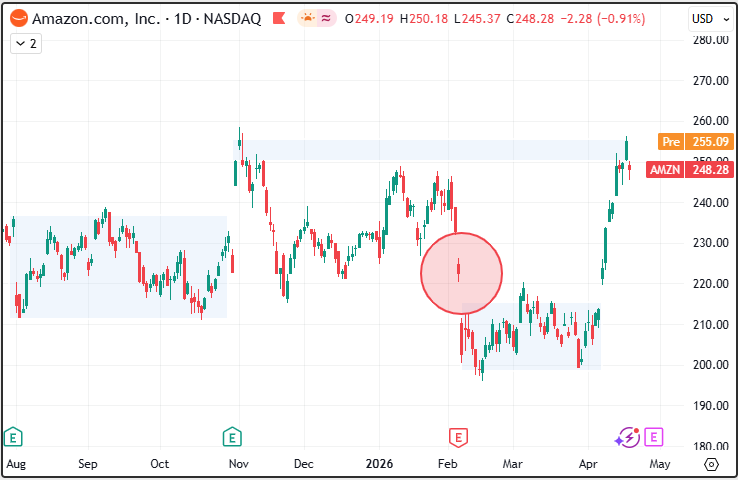
Capital expenditure guidance for 2026, projected at an elevated level of approximately $200 billion, emerged as a defining element of the earnings release. These investments, directed toward AI infrastructure, the expansion of Amazon Web Services, and the Kuiper initiative, were interpreted to some extent as a near-term headwind on financial performance, contributing to the negative price reaction.
The core challenge facing management lies in convincing the market of its ability to convert this intensive investment cycle into tangible revenue growth and margin expansion within a foreseeable timeframe. This challenge is further amplified by ongoing comparisons with Microsoft, which has demonstrated a more monetization of AI investments. As such, greater clarity on the trajectory of returns and capital allocation efficiency will be important in shaping investor sentiment in the periods ahead, particularly as markets look toward the upcoming earnings release.
Capital Spending Efficiency
At this stage, the market’s focus is not just anchored to the absolute size of spending, but also paying attention to the efficiency of capital allocation. Investors are seeking clearer signals that these investments are underpinned by tangible demand. In this context, indications that demand for Trainium chips is exceeding current capacity could reframe the capex narrative from a near-term burden to a growth enabler.
A Strategic Bet on the AI Ecosystem – Anthropic & OpenAI
Amazon’s strategic investment in Anthropic, potentially reaching $25 billion, alongside a commitment that could translate into up to $100 billion in spending on Amazon Web Services, reflects a great effort to build an integrated and scalable AI ecosystem. This arrangement support long-term demand for Trainium chips and Graviton processors, and also enhances revenue visibility. With OpenAI maintaining an early lead in the space thus far with a fast growing competition, this move signals a proactive positioning within the competitive landscape while offering a degree of support to medium-term margin stability.
AWS: Durability in a Competitive Environment
The core of the valuation debate remains tied to AWS’s ability to sustain growth at or above 24% year-on-year, a key threshold between supportive pricing dynamics and intensifying competitive pressures. This trajectory is closely linked to the pace of AI adoption and workload migration trends, while downside risks persist in the form of elevated defensive spending required to protect market share against Microsoft and Google.
Investor Sentiment
Beyond the top and bottom lines, market attention is increasingly concentrated on the trajectory of free cash flow, which has emerged as one of the most sensitive valuation anchors for the stock. Following last quarter, investors are looking for greater clarity in cash flow management that would support a more balanced reassessment of the company’s financial trajectory in the current phase.
The material provided here has not been prepared in accordance with legal requirements designed to promote the independence of investment research and as such is considered to be a marketing communication. Whilst it is not subject to any prohibition on dealing ahead of the dissemination of investment research we will not seek to take any advantage before providing it to our clients.
Pepperstone doesn’t represent that the material provided here is accurate, current or complete, and therefore shouldn’t be relied upon as such. The information, whether from a third party or not, isn’t to be considered as a recommendation; or an offer to buy or sell; or the solicitation of an offer to buy or sell any security, financial product or instrument; or to participate in any particular trading strategy. It does not take into account readers’ financial situation or investment objectives. We advise any readers of this content to seek their own advice. Without the approval of Pepperstone, reproduction or redistribution of this information isn’t permitted.